If you ask anyone what comes to mind when they think of Kenya, chances are safaris will be mentioned. This is entirely fair: safaris are a big deal in Kenya. But they’re not the only big deal you’ll find here. Travellers to this friendly East African nation are treated to extraordinary landscapes and endless opportunities for adventure, as well as a wealth of fascinating cultures. If they happen to spot one of the Big Five, too, that’s a bonus.
Where to look on the map
Kenya takes pole position in East Africa, surrounded by Somalia, Ethiopia, South Sudan, Uganda and Tanzania. An area of about 580,000km² puts it on a par with France and Ukraine. Within its borders, you can find everything from mountainous highlands and vast desert wildernesses to never-ending savannas and the Great Rift Valley. Thanks to a 500km tropical coastline, Kenya adds access to the waters and beaches of the Indian Ocean to its list of attractions.
Kenya is chopped in half by the Equator, which means temperatures are relatively consistent throughout the year. But don’t be fooled into thinking the same conditions prevail across the whole country. Terrain, position and altitude all have an influence and leave Mombasa sizzling in heat, while Mount Kenya is powdered with snow.
From prehistory to post-colonialism
If you want to walk in the footsteps of the first humans, Kenya’s the place to come. It’s a country rich in archaeological sites that tell the tale of human evolution from earliest times. The oldest stone tools ever found – clocking in at 3.3 million years old – were unearthed at Lake Turkana in the north of Kenya. In 1999, archaeologists discovered a 3.5 million-year-old skull identified as being from a previously unknown branch of the human family and named Kenyanthropus platyops or ‘flat-faced man of Kenya’.
Over the millennia, multiple ethnic groups, both indigenous and migratory, inhabited Kenya, speaking Bantu, Nilotic, and Cushitic languages. As hunters and farmers gradually became traders, visitors from the Arabian Peninsula and India, and then Europe, were attracted to Kenya. First, the Portuguese, then the Omanis, dominated much of the East African coast. Then, in 1895, the British established the East Africa Protectorate. It wasn’t until the 1960s, after the Mau Mau rebellion, that Kenya was freed from British rule. All of this explains the country’s rich and complex culture. More than 40 distinct ethnic groups are recognised here, each contributing something unique to the visitor’s experience.
Lakes, mountains and wide-open plains
For school groups with an interest in geography, biology and ecology, Kenya is hard to beat. In the north, arid desert and semi-arid territories are sparsely populated. Here, you can explore the Great Rift Valley and Lake Turkana, which is the world’s largest permanent desert lake and home to one of Africa’s largest populations of Nile crocodiles. Turkana’s turquoise waters, combined with the surrounding volcanic landscape, make this an otherworldly spot where it’s easy to see the powerful forces that shaped the Earth.
Inland, in the centre of Kenya’s interior, Mount Kenya rises from flat grassland to over 5,000m. This triple-peaked extinct volcano is Africa’s second-highest mountain, beaten only by Kilimanjaro. While bucket-list status makes Kilimanjaro a fairly busy proposition, Mount Kenya is the less crowded alternative for hikers keen to discover glaciers, bamboo forests and Alpine zones where bizarre giant plants grow.
Kenya’s national parks are what many travellers come for. As there are 24 dotted across the country, you have plenty to pick from. An additional 15 national reserves and 6 marine parks and reserves add to the choice. Maasai Mara and Amboseli are the names you’re most likely to be familiar with. Around 10% of Kenya’s land is protected, which allows the country to carry out extensive conservation efforts while attracting valuable tourist income. Today, rather than shooting the Big Five – lions, leopards, rhinos, elephants and buffalo – visitors come on safari to observe these animals in their natural habitat. For student travellers, the opportunity to participate in research projects with expert scientists is a once-in-a-lifetime experience.
The urban jungle
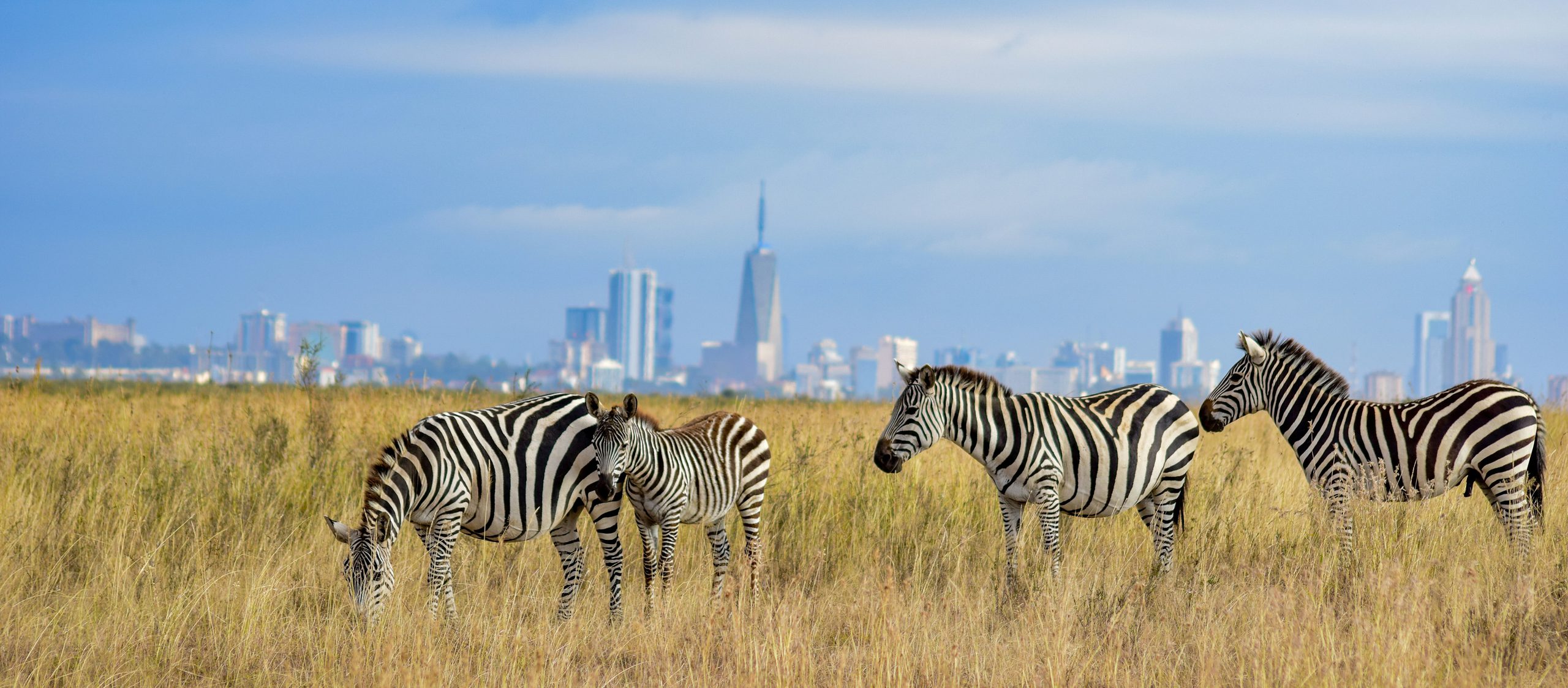
Despite its size, Kenya counts its cities – Nairobi, Mombasa, Kisumu, Nakuru and Eldoret – on one hand. Nairobi, the capital, sits inland in the south-central highlands. It started life as a colonial railway hub and remains Kenya’s industrial centre. A burgeoning tech sector has earned it the nickname ‘Silicon Savannah’, yet, under five miles south of the city lies Nairobi National Park, where giraffes, zebras and rhinos roam with skyscrapers glinting in the background.
Once of strategic importance for traders, the port city of Mombasa now offers visitors easy access to Kenya’s coast. It’s a hot and humid place that manages to be both chaotic and laid-back at the same time. Its culture reflects Swahili, Arab, Indian and European influences. Nowhere can this mix be better observed than in Mombasa’s food scene.
Good to know
- Single-use plastic bags have been banned in Kenya since 2017, so don’t take any into the country, even as wrappers in your luggage. As single-use plastics, including bottles and straws, were banned in national parks and reserves in 2020, you’ll need to bring a reusable water bottle.
- There’s a risk of contracting malaria in Kenya, although it’s relatively low in Nairobi and in the highlands above 2,500m. You should seek advice about anti-malarial treatments before travelling and wear trousers and long-sleeved tops where mosquitoes are present.
- You’ll want to purify your drinking water through boiling, tablets or filtration.
- While English and Swahili (Kiswahili) are the official languages, many ethnic tongues are also spoken. In the cities, you’ll hear Sheng being spoken. This is an ever-changing street slang that blends Swahili and English with local dialects.
- Thanks to Kenya’s position on the equator, it experiences only two seasons, rather than four. From June to October and December to March, the climate is generally dry. The ‘short rains’ fall in November and the ‘long rains’ come in April and May. Each period has its pros and cons. The national parks will be scorched in the dry seasons but game-spotting is easier, as animals congregate around watering holes. The legendary Great Migration of zebras and wildebeest in the Masai Mara peaks between July and September. When the rains come, grasslands become lush and green, young animals are born and visitors are fewer.
Inspired to visit? Check out our Kenya itineraries or talk to us about bespoke expeditions.