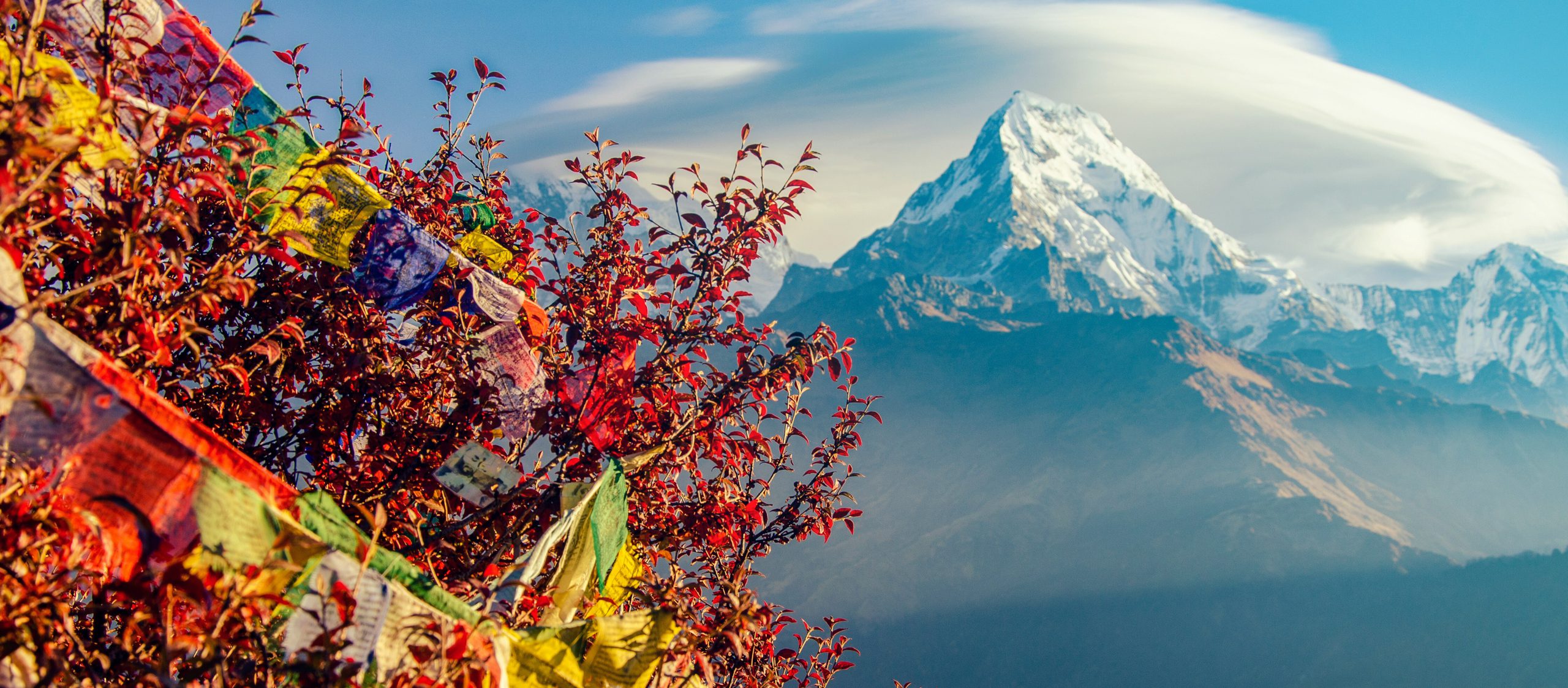
With the Himalayas running the full length of Nepal’s curved rectangle of territory, it’s unsurprising that the mountains pull a lot of focus for foreign visitors. Around 75% of the country is mountainous and it’s home to eight peaks that rise to over 8,000 metres. Given that there are only 14 such mountains in the world, that’s quite a claim to fame. You’ll find Mount Everest here, as well as the Annapurna Massif, which offers unrivalled trekking experiences.
At lower altitudes, below the high, snow-covered mountains (himal) and the middle hills (pahad), fertile plains (terai) stretch out towards India. Here, by contrast with the frigid temperatures in the mountains, the climate is tropical, making this the country’s agricultural heartland.
A unique nation
Nepal is boxed in on three sides by India and, to the north, looks towards Tibet and greater China. This position, buffering two powerful states, is of immense geopolitical importance. Until the 1950s, the country’s hereditary rulers practised a policy of isolation and kept the borders closed. As a result, Nepal feels enigmatic. Add in the inaccessibility of much of its terrain and you can understand why this is one of the world’s least developed nations.
At just shy of 150,000 km², Nepal is small. Despite this, it’s astonishingly diverse in religion and culture. While most Nepalis are Hindu or Buddhist, adherents to Christianity, Jainism, Sikhism and Bon faiths can also be found here. As if to reflect this melting-pot approach, even the capital city, Kathmandu, has sprawled along the Kathmandu valley and joined up with the neighbouring cities of Patan and Bhaktapur.
Urban life
During Nepal’s long isolationist period, urban development was limited. Then, from the 1950s onwards, things went into overdrive. In Kathmandu, the result is a bewildering mash-up of the ancient and modern. Streets get crowded and can feel chaotic, but that’s part of the city’s appeal. Expect loud and vibrant bazaars to rub shoulders with temples. The labyrinthine tourist district of Thamel is packed with souvenir and handicraft stalls, as well as plenty of places to eat.
Kathmandu, Patan and Bhaktapur each have a UNESCO-recognised Durbar Square, or royal palace complex. The one in Kathmandu was extensively damaged by the earthquake that hit the region in 2015, leaving Patan’s as the best-preserved option. Altogether, Patan offers visitors an unspoiled insight into medieval Nepalese architecture and temples, with considerably less crowding and pollution than the capital.
Don’t miss: Swayambhunath Temple. This ancient pilgrimage site sits on top of a wooded hillock 3km from the centre of Kathmandu. It’s home to a population of sacred monkeys, so is also referred to as the Monkey Temple. The white domed structure, known as a stupa, is topped with a gold spire. Each side of the spire features a pair of eyes representing the all-seeing wisdom of the Buddha.
Head for the heights
Pretty much every visitor to Nepal makes a beeline for the Himalayas. Treks can be as gentle or challenging as you like and take you from plains and forests to river banks and craggy ridges. Even undemanding walks get a shot of adrenaline, thanks to the plentiful suspension bridges that crop up en route. Colourful prayer flags can be seen fluttering in the wind at every village, temple and pass.
As Nepal doesn’t suffer from a shortage of peaks, every vista offers up a mountain with a story behind it. Everest is, of course, the big daddy of them all – you’ll find plenty of paths, lookouts and monasteries that offer spectacular views. When it comes to trekking in the Himalayas, slow and steady wins the race, with plenty of breaks to help your body acclimatise to the altitude.
Don’t miss: the Sherpa Museum and Visitor Centre at Namche Bazaar, where you can get an insight into what makes Sherpa culture unique and how the people and the mountains are inextricably linked.
Going on safari, Nepali-style
Nepal might not be your first choice of destination for a safari, but it will surprise you with what it has to offer. The lowland nature reserves and national parks are teeming with aquatic and birdlife, as well as iconic species such as Bengal tigers, Asian elephants and Mugger and Gharial crocodiles. You can explore dense jungles and open grasslands on foot or by jeep. If you want to explore the rivers, canoes are the way forward.
White-water rafting is on hand for those who want adventures with plenty of thrills thrown in. The rapids are graded from 1 to 6 according to the international scale – opt for a grade 3 if you want to challenge your manoeuvring skills.
Don’t miss: rafting on the Seti River, where the water can be comparatively warm, considering it originates in the Himalayas.
Inspired to go on a Nepalese adventure? Check out the Nepal itineraries from STC Expeditions. All of our trips are led by local in-country guides with expertise on the terrain and geography. Thanks to these well-connected leaders, your group will meet local people from varied backgrounds to learn about their lives, beliefs and experiences.