One of the harder parts of booking a school expedition is justifying the educational value, be that the biodiversity of Mozambique's oceans or the religion and culture of India. A trip has to earn its place on the calendar and its cost to the school. Few of the places we travel to stretch across as many subjects as Japan does, which is a large part of what makes it such an easy trip to build a case for.
Start with geography. Japan sits on the meeting point of several tectonic plates, which is why it gets so many earthquakes, volcanoes and tsunamis, and that makes it a fieldwork opportunity you can't recreate in a classroom. In Hakone, a volcanic valley a couple of hours from Tokyo, vents push steam and gas up through the ground and the soil and water run yellow with sulphur. Locals boil eggs in the hot volcanic pools; the water turns the shells black, and the story goes that eating one adds seven years to your life. On a clear day, Mount Fuji sits behind the whole valley.
The religious side is just as rich. Japan practises mainly Shinto and Buddhism, and students see both up close. Shinto is the indigenous religion, built around kami, the spirits found in nature, and its most famous site is Fushimi Inari near Kyoto, where thousands of vermilion torii gates form tunnels winding up the mountainside. Buddhism has left the country an enormous number of temples. At Tōdai-ji there is a bronze statue of the Buddha housed in one of the largest wooden buildings on earth, big enough that it takes a moment to work out the scale of it.
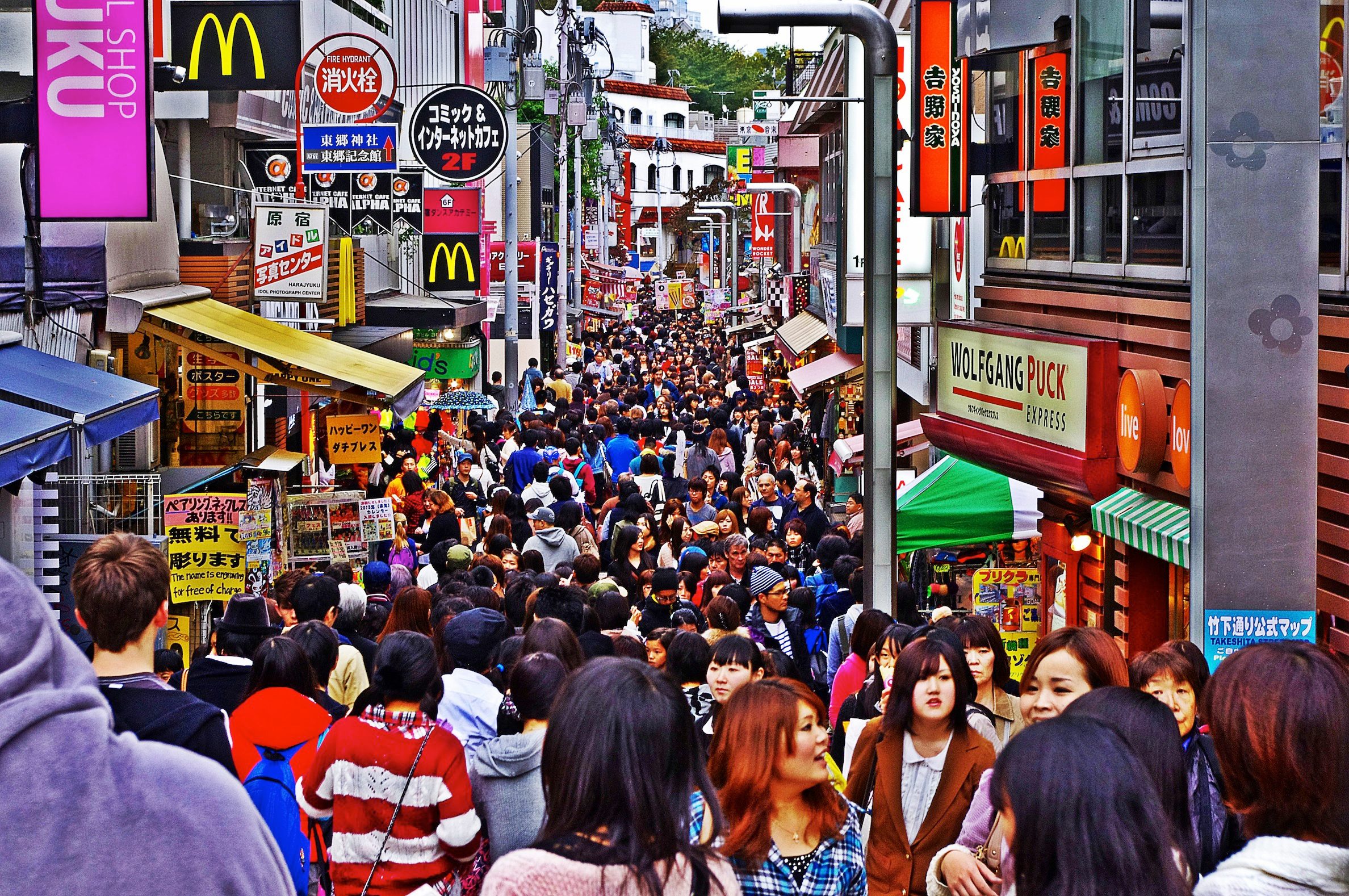
For all the ancient sites, most trips begin in Tokyo, and the jump from temple to city is part of what students take away. Shibuya's scramble crossing sends thousands of people across in every direction at once and somehow nobody collides. Tokyo is also where the science and design subjects find their footing: the bullet train that carried you across the country, the robotics and technology Japan is known for, and the sheer engineering of a city that size running as smoothly as it does.
Then there's history. Hiroshima isn't on any of our pre-written itineraries, but it's a stop we can build in if a school wants it, and for a history or PSHE group it's well worth asking about. The skeletal A-Bomb Dome still stands where it was left, and the Peace Memorial Park and Museum turn the events of 1945 from a line in a textbook into something students carry with them long after the trip.
The everyday differences land almost as hard as the landmarks: shoes coming off indoors, a packed commuter train that stays almost silent, slurping your noodles turning out to be a compliment rather than bad manners. And the timetable keeps going from there, with woodblock prints and calligraphy for art and design, and a completely different approach to cooking and presentation for the food room.
That range is the real reason Japan works so well for a school. Most destinations sell themselves to a single department. Japan lets a geography teacher, an RS teacher and a history teacher co-lead the same trip, which spreads the cost across more of the school and gets more staff behind it from the start. When you are the one making the case to a head, a trip that serves three departments at once is a far easier sell than one that only serves yours.