I've approached writing this article with trepidation. After all, India is the biggest country that we travel to, and certainly one of the most diverse and culturally interesting. However, I'm going to do my best to do India justice.
We offer three base itineraries for an India expedition: Kerala (Nature and Culture); Culture, Adventure and Religion; and Ladakh (Northern India). All three are genuinely different trips rather than variations on a theme. It's also worth remembering that these are a starting point, not a fixed menu. We can be flexible, within reason, in shaping an itinerary around an activity you particularly want to include.
The Kerala trip, Nature and Culture, is the gentlest of the three. Its highlights include time at the Thattekkad Bird Sanctuary on the Periyar River, a Butterfly Forest Trek near Suryanelli, and time spent in a local village. Being a school expedition, it's important to consider the educational value, and here the pull is strongly biological: learning about native bird species and, more broadly, about the environment and wildlife of the region.
The Culture, Adventure and Religion trip earns its name. In eleven days it takes in three living faiths: the Golden Temple at Amritsar, the spiritual heart of Sikhism; Dharamshala, the home in exile of the Dalai Lama and the Tibetan Buddhist community; and Rishikesh on the Ganges, reached by sleeper train, where the days begin with riverside yoga and end with the Aarti ceremony. For a religious studies department that's a rare thing: three religions met where they're actually practised rather than read about in a textbook. It isn't all quiet reflection, though. There's white water rafting down the Ganges and ziplining over it, and the Taj Mahal to finish.
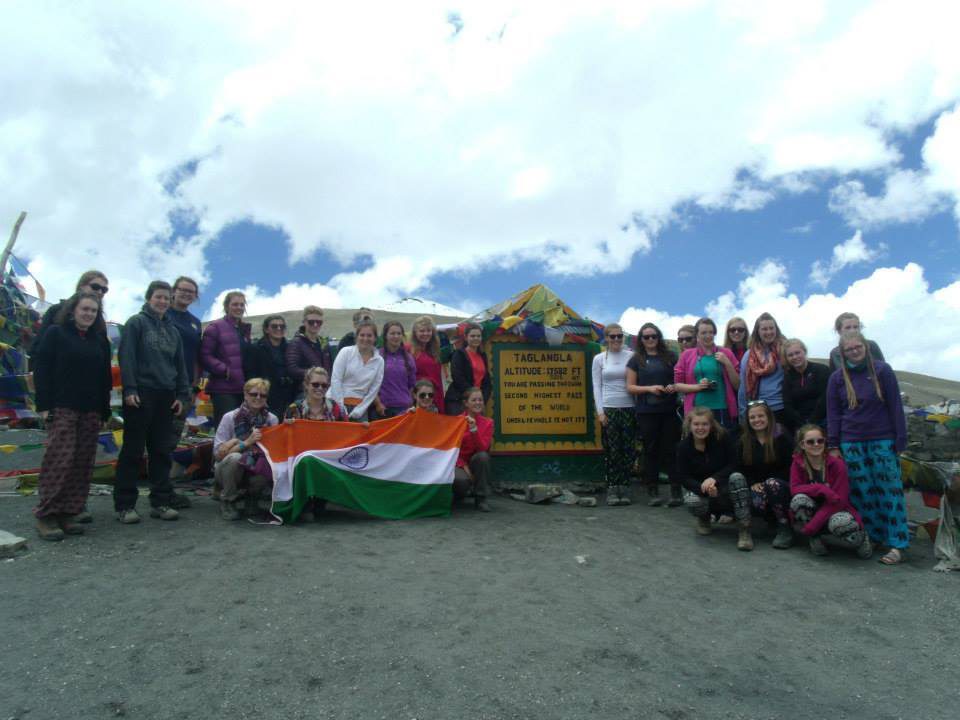
Ladakh, the Northern India Adventure, is the most demanding of the three, and the most rewarding for it. It has the cultural set pieces, from Delhi to the Agra Fort and the Taj Mahal, and an early start at Thiksey monastery to join the monks in prayer. But the real highlight (and it must be some highlight to rank above the Taj) is a multi-day Himalayan trek over passes at 4,800m, camping among shepherds' huts along the way. This is where the geography stops being something students read and becomes terrain they walk through, and where a week of hard days builds a kind of resilience that's difficult to teach any other way. It ends with a community day: agriculture, social enterprise, and time spent with local students.
India's history is deep, rich and fascinating. Mughal architecture still stands today, not only in the Taj Mahal at Agra but also the Red Fort in Delhi. Learning about the great Mughal emperors, Babur, Humayun, Akbar the Great, Jahangir, Shah Jahan and Aurangzeb, is a fascinating dive into an India that existed before the British Empire.
Beyond the three base itineraries, we can build in bespoke stops, and previous groups have done exactly that. One example is Jim Corbett National Park, India's first national park, named after the hunter turned conservationist who lobbied to protect it. Corbett had been famed for tracking and killing man-eating tigers and leopards before he turned to protecting them and the forests they lived in. Today the park covers around 521km², with the wider Tiger Reserve extending to roughly 1,288km², and it's home to Bengal tigers, Asian elephants, leopards and crocodiles.
At the heart of the STC Expeditions ethos is our commitment to responsible travel, sustainability and our charity work. We carbon label our expeditions so that a school can weigh the footprint of a trip alongside everything else, and our work with Trees for Life means that every passenger on your expedition has a tree planted for them in the Scottish Highlands.
I said at the start that I'd approached this with trepidation, and I stand by it: there's no doing India justice in a few hundred words. What I hope has come through is why it's one of our favourite places to take a school, and how differently a trip here can turn out depending on what you're after. If any of it has caught your interest, get in touch and we'll build something around your group.